


This post may contain affiliate links. Please read my disclosure policy.
Recipe Highlights
What’s your favorite ramen topping? For Mr. JOC, it’s always chashu (チャーシュー)—those melt-in-your-mouth, juicy slices of braised pork belly. For me, it’s the marinated soft-boiled ramen egg (ajitsuke tamago). Together, they’re unbeatable.
Chashu is surprisingly easy to make at home. The prep and active cooking time are minimal, and you just need patience for the overnight rest. After that, you’ll have deeply flavored, silky-tender pork that tastes like it came straight from your favorite ramen shop. Here’s why I keep coming back to this recipe:
- Melt-in-your-mouth tender – Low and slow braising transforms pork belly into silky, fork-tender slices with deep, savory flavor.
- Two ways to make it – Roll it into a log for a classic ramen-shop presentation, or keep it flat for a quicker, easier prep.
- Over 20-year family favorite – I’ve been making this exact recipe for over 20 years. Stay close to the kitchen while it simmers, and the reward will be absolutely worth it.
If you love pork belly? Try my Kakuni, Mille-Feuille Nabe, and Rafute (Okinawan Braised Pork Belly) next!

What is Chashu?
Chāshū (チャーシュー) is a Japanese braised pork dish adapted from Chinese char siu (叉燒). While the Chinese original is roasted over fire or in a hot oven, Japanese chashu is braised low and slow instead—a quieter technique with a dramatically different result.
We also call it nibuta (煮豚), meaning “simmered pork,” to distinguish it from yakibuta (焼豚), or “grilled pork.” So despite sharing a name with its Chinese cousin, the cooking method is quite different.
Most often, chashu tops a bowl of ramen or cooks together with steamed rice as chashu don (チャーシュー丼). Either way, it’s one of the most beloved pork dishes in Japanese home cooking.
Japanese Chāshū vs. Original Char Siu
You’ve probably seen glistening slabs of char siu hanging in Chinese deli windows. They may look similar, but the two dishes are quite different.
- Texture – Chashu is fork-tender and succulent. Char siu has a firmer bite with a smoky, grilled finish.
- Seasoning – Chashu uses Japanese pantry staples: soy sauce, sake, and sugar. Char siu is marinated in hoisin sauce, honey, rice wine, five-spice powder, and red food coloring.
- Cooking method – Chashu is gently braised. Char siu is roasted or barbecued over high heat.
Rolled vs. Non-Rolled Chashu
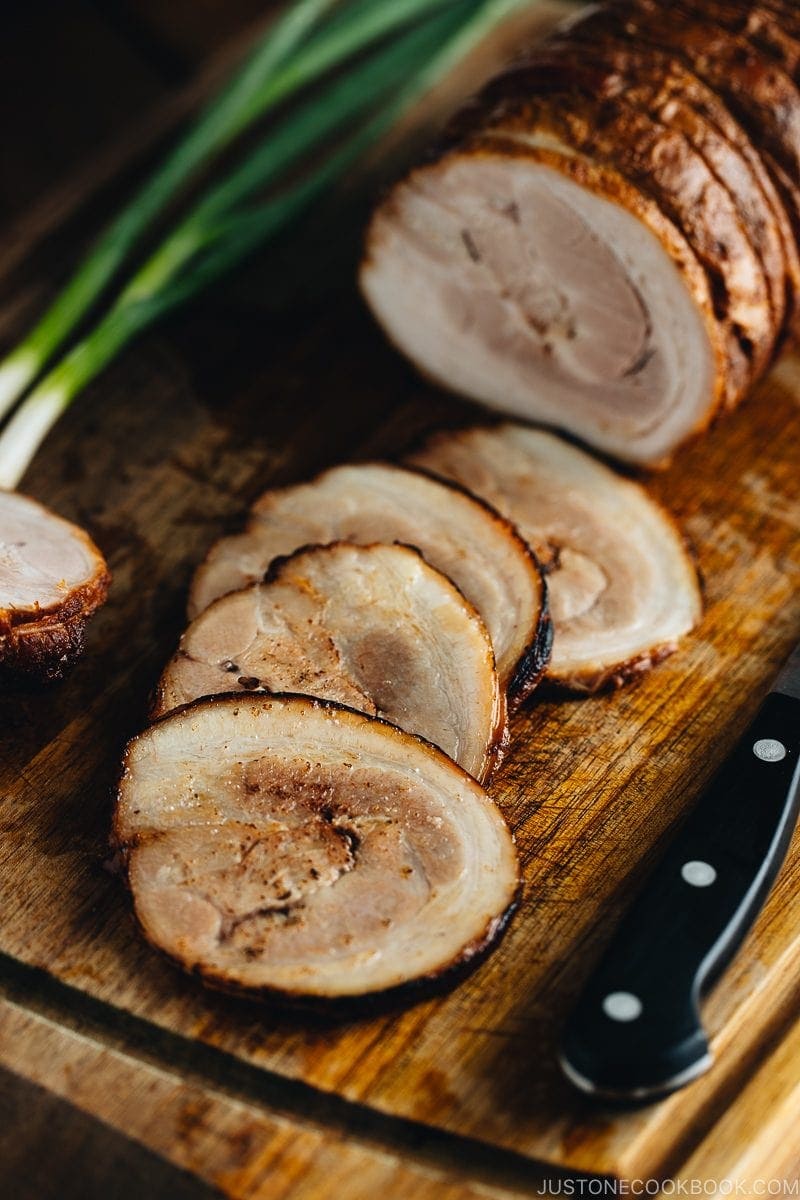
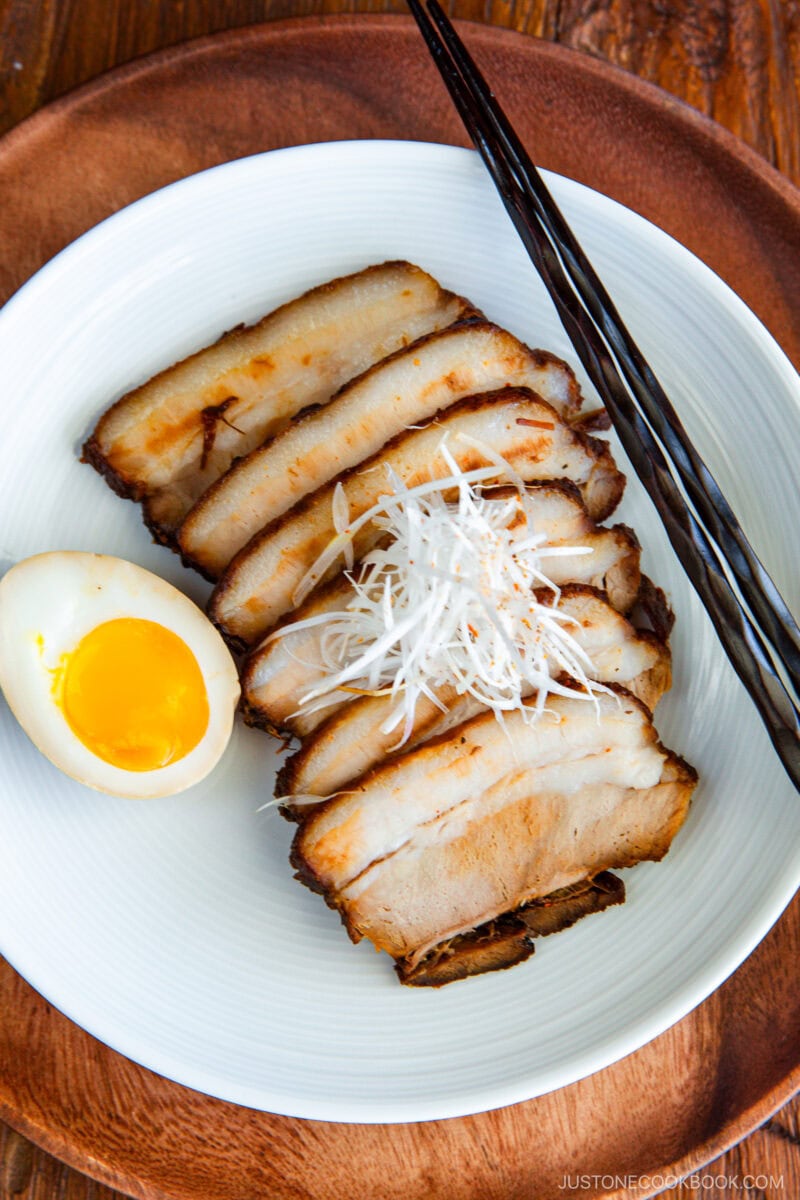
Both styles are common at ramen shops across Japan—neither is wrong. Here’s how to choose:
Rolled Chashu (Log)

Rolling a slab of pork belly into a log and tying it with butcher’s twine is the classic ramen-shop method.
Here’s why it works:
- Keeps its shape as the fat renders
- Stays moist — the interior isn’t directly exposed to the sauce, so it absorbs flavor without drying out
- Looks beautiful on a bowl of ramen
🙋🏻♀️ Why not increasing the seasonings to fully submerge the roll?
Ramen shops do this by combining yesterday’s sauce with a fresh batch—but for home cooking, that’s wasteful. My method is to rotate the chashu frequently instead, which works just as well. I braise the log for two hours, rotating and letting it absorb all the flavor.
Non-Rolled Chashu (Block)

Smaller pork belly blocks (¾–1 lb) are a great choice when you want less chashu or an easier prep:
- No rolling or tying required—just sear and braise
- Shorter cooking time—just 1 hour, since the flat slab (3/4–1 lb) absorbs flavor quickly
- Use an otoshibuta (drop lid) to keep the sauce circulating and prevent too much evaporation
The overnight rest is key. It deepens the flavor and firms up the meat so you get clean, even slices.
Choosing the Right Cut of Pork for Chashu
Pork belly is the ideal choice—its fat-to-meat ratio gives chashu its signature melt-in-your-mouth texture.

In Japanese cooking, we use pork belly without the rind (except in some Chinese-influenced or Okinawan dishes). If yours comes skin-on, ask the butcher to remove it or trim it yourself with a sharp knife.
Pork shoulder is a workable substitute, and pork loin can be used in a pinch, but neither will give you the same silky result.
Pro Tip: Where to Buy Pork Belly
Pork belly isn’t always on display, but most butchers keep it on hand. Don’t hesitate to ask and if you need it the same day, call ahead since it often comes frozen and needs time to thaw.
Korean grocery stores are my top recommendation. They carry multiple thicknesses and sizes, and the butcher will often cut a custom piece for you.
Ingredients for Chashu
- pork belly block (skin removed if skin-on)
- Tokyo negi – leek or green onions work too
- fresh ginger slices
- neutral oil – for searing
- sake
- soy sauce
- water
- sugar
How To Make Chashu Pork
- Roll and tie the pork belly into a log with kitchen twine, or skip this step and use smaller blocks.
- Sear the pork belly over high heat in a heavy-bottomed pot until the surface is browned.
- Braise the meat in a soy sauce-based seasoning on low heat for 1–2 hours, letting the sauce reduce and concentrate.
- Rest overnight — transfer to a bag or container with some cooking sauce and refrigerate to marinate.
- Slice thinly the next day, thick enough to pick up with chopsticks.
How To Roll and Tie Pork Belly

- Orient the pork belly so one or both ends show the layered meat-and-fat pattern.
- Roll and trim into a compact log and cut any excess (save it for another use).
- Tie and secure one end with a double knot, then wrap 2–3 more times.
- Cross to the far end and wrap 2–3 times tightly.
- Work back toward the start, wrapping every ⅓ inch (1 cm).
- Tuck and return the twine under a few middle wraps and bring it back to the start.
- Finish with a double knot.
You can find the step-by-step instructions and video in the recipe card.


Nami’s Recipe Tips
- Sear thoroughly. A good sear builds layers of flavor that carry through the entire dish. I use a cast iron pan—it holds heat evenly and handles high temperatures well.
- Don’t skip the ginger and Tokyo negi. They neutralize any off-odors in the pork and add subtle depth to the braising sauce.
- Rest overnight—no shortcuts. Eight hours in the refrigerator lets the pork fully absorb the braising liquid. This step is what takes chashu from good to great.
How To Slice Chashu

Once chilled overnight, the pork firms up and slices cleanly. A sharp bread knife makes the job easier. I typically slice only what I need for that meal, then cut the rest into 2–3 blocks and vacuum-seal them for the freezer.
How to Reheat Chashu
There are 3 ways to reheat chashu:
- Soak slices in warm cooking sauce until heated through.
- Drop directly into a bowl of hot ramen or noodle soup.
- Torch it — sear with a culinary butane torch for aburi chashu (炙りチャーシュー). Drizzle with hot cooking liquid before serving.
The torch method is my favorite — it adds a smoky, charred edge that takes the flavor up a notch.

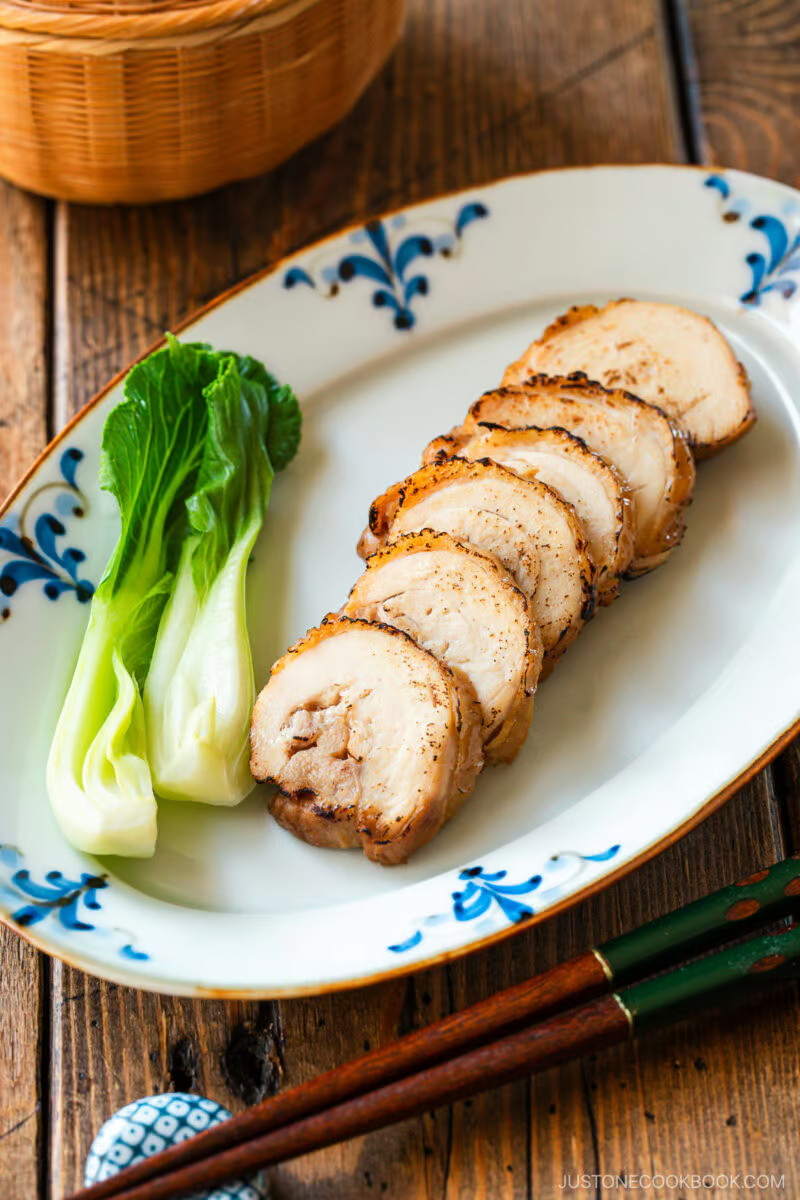
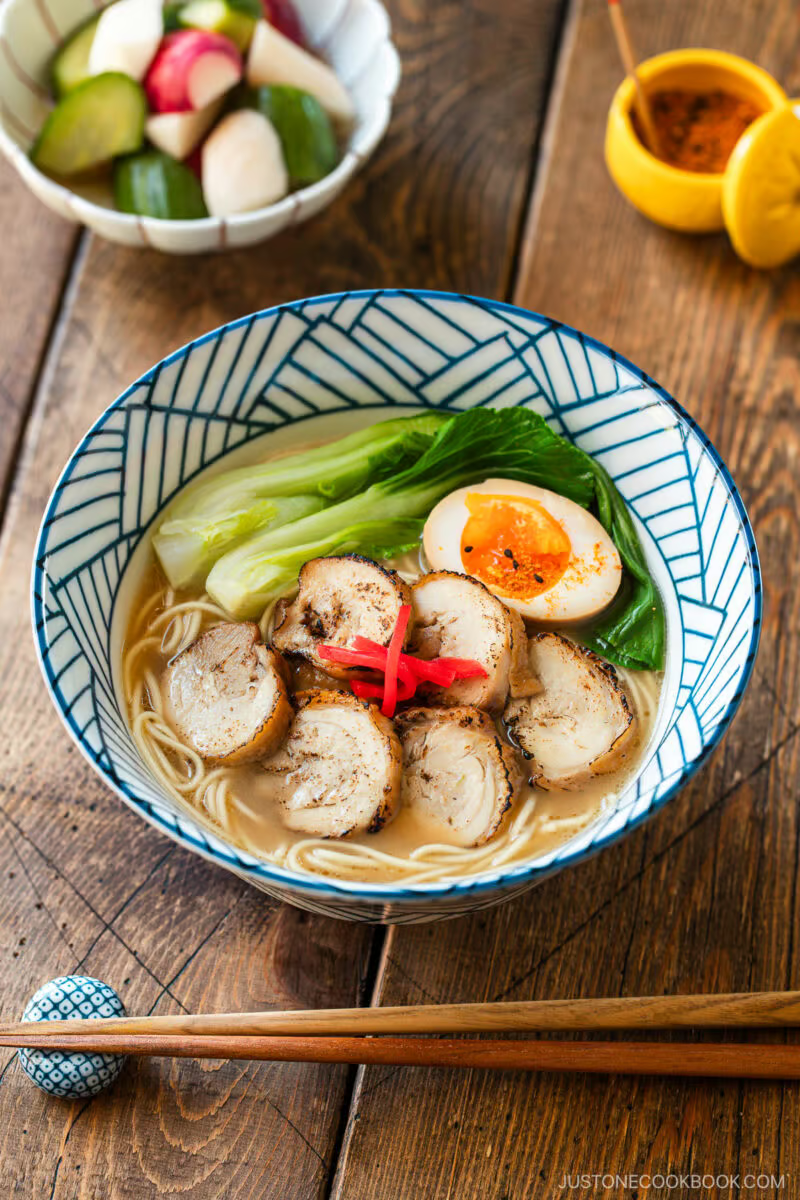
How to Enjoy Chashu
Besides enjoying chashu with ramen or as a main dish, you can also use it for many other dishes. Here are my suggestions:
- Noodle dishes – Hiyashi Chuka and Tsukemen
- Rice dishes – Chashu Fried Rice (great for using up edges and scraps).
- Sandwiches and buns – Stuff into Nikuman (steamed pork buns).

How to Use Leftover Chashu Sauce
- Stir-fry seasoning
- Marinade for grilling meat
- Marinade for Ramen Egg (ajitsuke tamago)

Wish to learn more about Japanese cooking? Sign up for our free newsletter to receive cooking tips & recipe updates! And stay in touch with me on Facebook, Pinterest, YouTube, and Instagram.
This recipe card covers two methods — Rolled Chashu (serves 8–10) and Non-Rolled Chashu (serves 3). Scroll to the second ingredients list for the Non-Rolled version. Instruction sets are separated with clear headers.
Chashu (Japanese Braised Pork Belly)

Ingredients
For a Rolled Chashu Log (serves 8–10)
- 1 pork belly block (2–2½ lb, 907–1134 g; roughly 8 x 9 inches, 20 x 23 cm each; remove the rind from your pork belly)
- 1 Tokyo negi (long green onion) (green part only; substitute with 1 leek or 2–3 green onions)
- 1 inch fresh ginger (unpeeled)
- 1 Tbsp neutral oil (for searing)
- 1 cup sake
- 1 cup soy sauce
- 2 cups water
- ⅔ cup sugar
For a Non-Rolled Chashu Block (serves 3; this is my original recipe posted on May 2011)
- ½ Tbsp neutral oil (for searing)
- ¾ lb pork belly block (for 1 lb (454 g) of meat, see Notes)
- 1 Tokyo negi (long green onion) (green part only; substitute with 1 leek or 2–3 green onions)
- 1 inch fresh ginger (unpeeled)
- ⅓ cup sake
- ⅓ cup soy sauce
- ⅔ cup water
- 3 Tbsp sugar
Instructions
FOR ROLLED CHASHU (Scroll down for the NON-ROLLED version)
- Before You Start: Please note that this rolled Chashu recipe requires an overnight resting time of 8 hours.
DAY 1
- Gather all the ingredients.

To Prepare the Pork Belly
- Roll up your 1 block of pork belly (2–2½ lb or 907–1134 g). Make sure one or both ends have a “bacon-like“ appearance, showing the varying layers of meat and fat. If your slab comes with the rind, remove it or ask your butcher to do it for you.

- Run some butcher twine under the far end of the log. Tie a double knot to secure the rolled end tightly. Make sure you leave a tail of about 3 inches (7.5 cm) of twine at the end.

- Next, tightly wrap the twine around the spot you just tied another 2 or 3 times to secure the starting point of the roll. Then, pull the twine to the opposite end of the pork belly roll. Tightly wrap the twine around that end 2 to 3 times to secure it.

- Next, start wrapping the twine around the roll back toward the starting point. Space each wrap ⅓ inch (1 cm) apart. Make sure you wrap the roll as tightly as possible.

- Once you reach the starting point, run the twine under some of the end wraps; this hooks the twine in place so you can reverse direction. Next, run the twine under 4 or 5 wraps going away from the starting point. Then, double back toward the starting point, running your twine under the wraps until you reach the original double knot.

- Find the 3-inch tail of twine that you left when you started. Tie a double knot with the tail and the long end of the twine, and cut the excess.

To Cut the Aromatics
- Cut the green part of 1 Tokyo negi (long green onion) and set aside; reserve the white part for another use. Cut 1 inch fresh ginger into 4 thin slices.

To Sear the Pork Belly
- Heat 1 Tbsp neutral oil in a cast-iron skillet (or regular frying pan) over high heat. Add the tied pork belly to the skillet.

- Sear the pork belly one side at a time, rotating it to make sure all sides are golden brown.

- It’ll take about 10–15 minutes all together.

To Prepare the Braising Liquid
- While the pork is searing, prepare the braising liquid. Put 1 cup sake, 1 cup soy sauce, 2 cups water, and ⅔ cup sugar in a heavy-bottomed pot (I used a Dutch oven) that will fit the chashu. Then, add the Tokyo negi (green part) and ginger slices.

To Simmer the Chashu
- Transfer the seared chashu roll to the Dutch oven.

- Bring the liquid to a boil over medium heat.

- Once boiling, skim off the foam and scum. Then turn the heat to low/simmer.

- Put an otoshibuta (drop lid) on top to press the ingredients down and limit the evaporation. You do not need to use a regular lid to control the evaporation. If you don’t have an otoshibuta, you can make one with aluminum foil (here’s how to make the otoshibuta).

- Simmer on low heat, and cover with the otoshibuta at all times for the next 2 hours, turning the chashu every 30 minutes.

- After 2 hours, the braising liquid has reduced a bit. Turn off the heat to let the chashu roll cool a little bit.

To Rest the Chashu Overnight
- Once the meat is slightly cooled, transfer it to a container or a plastic food vacuum-sealing bag, such as one for the FoodSaver system. (If you‘re doubling or tripling this recipe, put each chashu roll in its own bag.) Strain the leftover cooking liquid through a fine-mesh strainer.

- Add ½ cup of the cooking liquid into the bag. If using a container, add about 1 inch (2.5 cm) of the braising liquid to the bottom and cover.

- If using the FoodSaver bag, seal it with a FoodSaver sealer. Tip: Fold a piece of paper towel to plug the entry of the FoodSaver bag. This paper towel will absorb any extra moisture when you seal.

- Tip: I also made quick Ramen Eggs (Ajitsuke Tamago) with the leftover liquid. Simply cook and peel soft-boiled eggs, add them to a bag with ½ cup of the cooking liquid, and close. Cover the cooking liquid, and store the chashu, ramen eggs, and the cooking liquid in the refrigerator.

DAY 2
- Open the bag of chashu.

- Cut the twine with kitchen shears and remove the twine pieces completely.

- Slice the chashu into ¼-inch pieces and keep the end piece for Chashu Fried Rice!

- Place the chashu slices on a ceramic plate. Sear and enhance the flavor with a kitchen butane torch. You can also use a broiler in the oven. Enjoy them immediately or serve on your ramen.

- Scoop up and discard the solidified fat from the cooking sauce.

- Strain the sauce over a fine-mesh sieve to make sure the solidified fat is left behind. Pour the sauce into a mason jar or container and seal. The sauce will last for a month in the refrigerator. I use it for drizzling over the chashu and for making stir-fried dishes, marinades, and ramen eggs.

To Store
- You can store the chashu in the refrigerator for up to 7 days or 1 month in the freezer. I usually divide the rolled chashu into thirds and freeze 2 portions separately (for ramen right away, and Chashu Fried Rice and Chashu Bowl for later). Ramen Eggs should be consumed in 3–4 days if they are soft-boiled eggs and 7 days if hard-boiled eggs. The eggs get saltier the longer you keep them in the marinade, so remove them from the sauce when they have the right taste.
FOR NON-ROLLED CHASHU
- Gather all the ingredients. For small blocks of pork belly (about 1 lb) like I‘ve used here, you don’t need to roll them up before cooking, and the simmering time is just 1 hour (instead of 2 hours). Tip: To cook 1 lb (454 g) of pork belly, see the ingredients list in the Notes section at the end of the recipe card.

- Heat a cast iron skillet (or regular frying pan) over high heat. When the pan is hot, add ½ Tbsp neutral oil. Sear ¾ lb pork belly block fat-side down first, then flip over to sear the other side; this will take about 10 minutes.

- While searing, prepare a heavy-bottomed pot (or regular pot) that will fit the chashu. To the pot, add the green part of 1 Tokyo negi (long green onion), 1 inch fresh ginger (cut into thin slices), ⅓ cup sake, ⅓ cup soy sauce, ⅔ cup water, and 3 Tbsp sugar. Once you‘re done searing the meat, add it to the pot. Bring the liquid to a boil, skimming the scum and foam. Then, turn the heat to low/simmer.

- Put an otoshibuta (drop lid) on top to press the ingredients down and limit the evaporation. If you don’t have an otoshibuta, you can make one with aluminum foil (here’s how to make otoshibuta). Simmer on low heat for 1 hour, turning the chashu every 15 minutes and keeping an otoshibuta on at all times.

- After 1 hour, there is ½ inch of liquid left in the pot. Now, you have 2 options. Option 1: If you’re serving it right away, remove the otoshibuta and further reduce the sauce on low heat until the sauce thickens and you can see the bottom of the pot when you draw a line through the sauce with a spatula. Option 2 (recommended): Transfer the chashu to a container or bag with a little bit of cooking sauce and refrigerate overnight. Strain the leftover cooking sauce, transfer to a jar, and refrigerate.

- To serve, slice the chashu into ¼-inch (6 mm) pieces. Sear and enhance the flavor with a kitchen butane torch. Drizzle some reserved sauce and top with shiraga negi.If you stored the chashu overnight and don’t want to sear the chashu, you can reheat it by soaking it in hot cooking sauce.

Notes
- 1 lb pork belly block (454 g)
- 1 negi (long green onion) (substitute with 1 leek or 2-3 green onions)
- 1 knob ginger
- ½ Tbsp neutral-flavored oil (vegetable, canola, etc.)
- ½ cup sake (120 ml)
- ½ cup soy sauce (120 ml)
- 1 cup water (240 ml)
- ⅓ cup sugar (75 g, 5 Tbsp)
Nutrition
The nutrition facts shown are generated by an online calculator and are estimates only. Please consult a professional nutritionist for specific dietary needs.
Did you make this recipe?
Tag @justonecookbook on Instagram so we can see your delicious creation!
Editor’s Notes: This post was originally shared in May 2011. The first video was added in September 2014 with new images. New video and images are added in May 2019. The post was updated with more helpful information May 25, 2026.

